
Expert Tested · Field Report
Do Grounding Sheets Really Work? I Tested Them to Find Out

If you’re here, you probably saw a grounding sheet ad and thought: “There’s no way this is real.” I had the exact same reaction. Then I spent 10 weeks, a professional multimeter, and a sleep tracking wearable trying to prove myself right. Here’s the part I didn’t expect — the data didn’t cooperate.
The Problem With Grounding Sheet Reviews
Let’s start with why your skepticism is justified.
Search for grounding sheet reviews right now and here’s what you’ll find: affiliate sites that slap a “Best Grounding Sheet” label on whatever pays the highest commission. Amazon listings with thousands of five-star reviews that read like they were written by the same person. Brand websites citing “clinical studies” that were funded by the brand itself. And influencer posts where the person clearly got the product for free two days ago and is already calling it life-changing.
If that makes you suspicious, good. It should. Most of what’s written about grounding sheets online is marketing dressed up as honest advice. That’s exactly why I decided to stop reading reviews and start testing.
I Came Into This Expecting to Debunk Them
I’ve spent years testing sleep and wellness products for this site. Magnetic bracelets, infrared pajamas, “negative ion” pillows — I’ve watched them come and go. Most do nothing measurable. So when grounding sheets started showing up everywhere — claiming to reduce inflammation, improve sleep, and relieve pain just by connecting a bedsheet to your wall outlet — my assumption was that this was the same thing in fancier packaging.
I wasn’t looking for a product to recommend. I was looking for another wellness gimmick to cross off the list.
What changed my mind wasn’t a testimonial or a brand’s marketing page. It was a multimeter.
The Science Behind Grounding (It’s Simpler Than You Think)
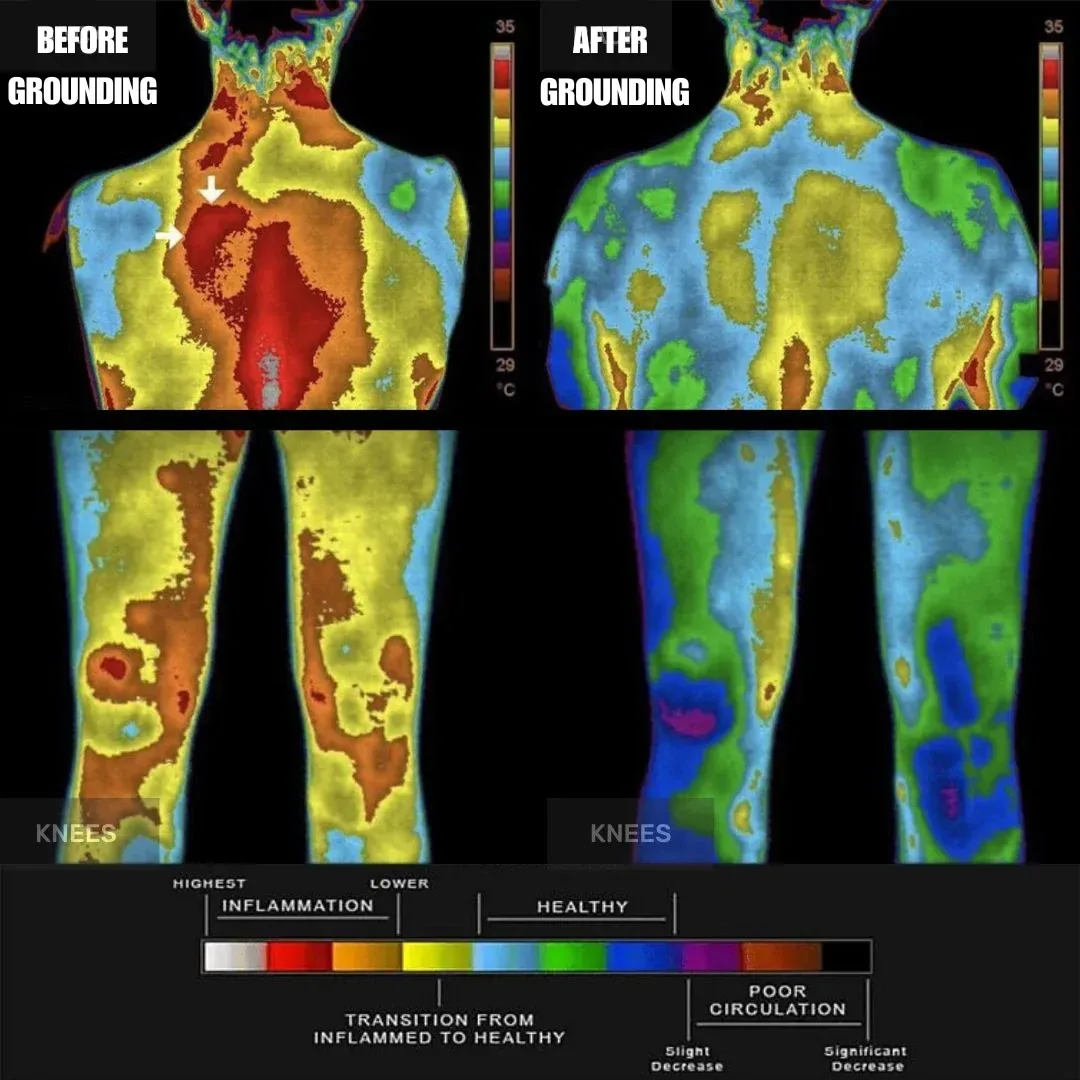
Before I get into what I found, here’s what grounding actually is — stripped of the marketing language.
Your wall outlet has a round grounding port that connects to a metal rod buried in the earth outside your home. A grounding sheet has silver threads woven into the fabric. You plug one end of a cord into the sheet, the other into that grounding port, and the silver creates a conductive pathway between your body and the Earth’s natural electrical charge.
The proposed benefit: this electron transfer may help reduce inflammation, calm the nervous system, and improve sleep quality. The mechanism is straightforward physics — silver conducts electricity, and the grounding port provides a genuine connection to Earth potential.
Here’s the key distinction most reviews skip over: the physics is not the question. Silver conducts. The grounding port is real. The connection to Earth potential is measurable. The real question is whether that connection makes any difference to your body — and whether the sheet you buy actually conducts at all.
That second part turned out to be the bigger problem.
What 10 Weeks of Testing Actually Showed
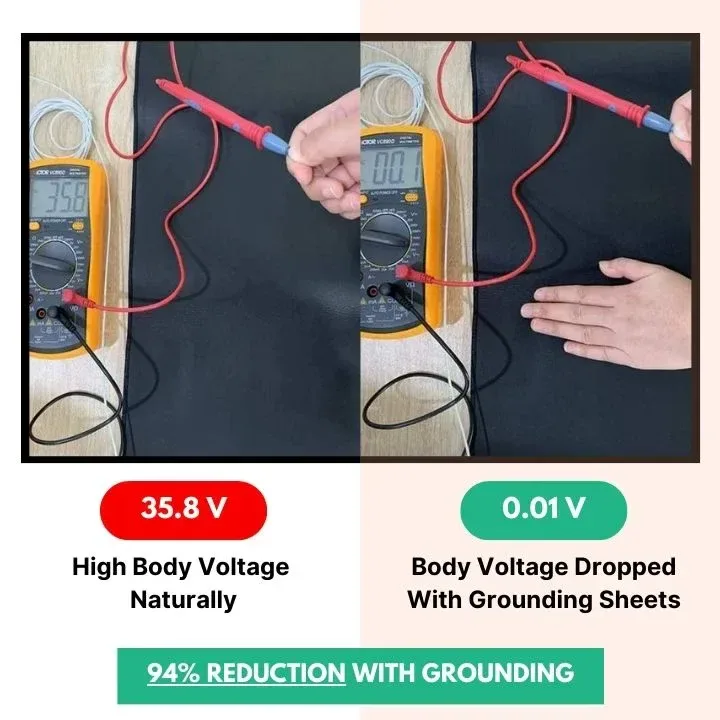
I ordered the leading grounding sheet brands on the market — plus a few budget options to establish a baseline — and ran two rounds of testing.
Round 1: Conductivity testing with a professional multimeter. This is the test most reviewers never bother with, and it’s the one that matters most. If a grounding sheet doesn’t conduct electricity across its surface, nothing else about it matters — it’s a regular bedsheet with a cord attached.
Some sheets — particularly cheap ones under $50 — barely registered on the multimeter. The silver content was too low to create a meaningful conductive pathway. Out of all the sheets I ordered, only 5 passed the conductivity bar worth sleeping on.
Round 2: 10 weeks of real sleep data. I rotated through those 5 finalists while wearing a sleep tracking wearable, with baseline weeks mixed in for comparison.
The sheets with adequate silver content (5-10%) showed real, measurable conductivity across the full surface area. When I plugged them in and lay on them, my body voltage dropped from typical indoor levels to near-zero — exactly what grounding theory predicts.
The sleep data was more interesting. Upfront caveat: this isn’t a clinical trial — it’s one person’s tracked data across 10 weeks. But the pattern was consistent enough to change my mind. After the first week on a high-conductivity sheet, my wearable started showing shorter sleep onset times and fewer nighttime wake events. By week three, my average sleep efficiency had improved noticeably compared to my baseline weeks. I rotated between sheets to rule out novelty effects — the pattern held. Higher-conductivity sheets consistently correlated with better sleep metrics, and by week five I’d stopped being a skeptic.
See Which Sheets Actually Passed My Testing →Here’s the Catch: Most Grounding Sheets Are Expensive Duds
This is the part that should concern you if you’re shopping. The majority of grounding sheets I tested failed to deliver meaningful conductivity. Not some of them — most of them.
The reasons come down to two things:
Silver content too low. Some brands use less than 2-3% silver, or apply a thin surface coating instead of weaving silver threads into the fabric. That coating washes away within weeks. Without enough silver, there’s no functional conductive grid — and no grounding. You’re paying $80-150 for a bedsheet with a useless cord.
Degradation after washing. Several sheets that tested well fresh out of the package lost 30-50% of their conductivity after just a few dozen washes. If the silver threads aren’t woven in properly, they break down fast. A sheet that “works” for the first month and then stops isn’t a grounding sheet — it’s a temporary grounding sheet with a permanent price tag.
So do grounding sheets work? Yes — but only if the sheet actually conducts, and keeps conducting after you wash it. The brand, the silver percentage, and the build quality are what separate a functional grounding sheet from an expensive placebo. And the gap between the best and worst products I tested was enormous.
What the Published Research Says
I’m cautious about citing studies in a product category this commercialized, because brands cherry-pick research aggressively. But there is legitimate peer-reviewed work worth noting:
A study in the Journal of Alternative and Complementary Medicine found that grounded sleep may support cortisol rhythm normalization — the hormonal pattern that governs your sleep-wake cycle. Participants reported falling asleep faster and waking less frequently.
Research published in the Journal of Inflammation Research suggests that grounding may reduce certain inflammatory markers. The proposed mechanism — free electrons from the Earth neutralizing free radicals — is physically plausible, though more controlled studies are needed.
My honest assessment: the research is promising but not definitive. What convinced me personally was my own tracked data, not the published studies alone. If you’re the type who needs large-scale clinical proof before trying anything, grounding sheets aren’t there yet. If you’re open to trying something where the physics checks out and the early evidence is positive, it’s worth a shot — as long as you pick the right sheet.
My Bottom Line
After 10 weeks of hands-on testing, here’s what I’d tell the skeptic I was before I started:
Grounding is real physics, not pseudoscience. The electrical connection is measurable with a $15 multimeter. The question is whether it produces a meaningful health benefit, and my tracked data says yes — with the caveat that this is personal data, not a clinical trial.
Most grounding sheets on the market will waste your money. Low silver content, thin coatings that wash off, and zero quality control mean the average buyer has a high chance of buying something that doesn’t actually ground them. The reviews won’t warn you because most reviewers never tested conductivity.
The difference between brands is dramatic. Sheets with 10% silver consistently outperformed 5% silver sheets — lower resistance, more uniform coverage, slower degradation, and faster improvement in sleep data. That said, more silver isn’t automatically better. One 20% silver sheet I tested lost points for cable failures and a weak return policy, while a well-built 10% sheet with a longer guarantee pulled ahead overall. Build quality and guarantee terms matter as much as raw silver percentage. Both tiers still crushed the budget brands that barely conducted at all.
If you’re going to try one, protect yourself with three non-negotiables:
- At least 10% woven silver thread — not a thin surface coating that washes off after a few cycles
- A 60-90 night money-back guarantee — long enough to actually feel whether it works for your body
- Fast US warehouse shipping — no overseas waits, no tariff markups, no customs surprises
I tested the top brands and narrowed it to 5 that actually check all three boxes.
See My #1 Pick — and Why It Won →Frequently Asked Questions
Q: Do grounding sheets really work, or is it placebo?
A: In my testing, sheets with adequate silver content (5-10%) produced measurable changes in body voltage and correlated with improved sleep tracking data. Sheets with minimal silver content showed no meaningful effect. The quality of the sheet matters enormously — which is why most people who say “grounding sheets don’t work” probably bought a bad one.
Q: How quickly should I expect to notice something?
A: In my experience, trackable changes appeared within the first week on high-conductivity sheets. Subjective improvements in how I felt in the morning took about 2-3 weeks to become consistent.
Q: Are grounding sheets safe?
A: Yes. No electricity flows through the sheet — it only connects to the grounding port, which carries no current. If you have a pacemaker or electrical implant, consult your doctor.
Q: Can I just walk barefoot outside instead?
A: Barefoot ground contact achieves the same electrical connection. The advantage of grounding sheets is duration — 7-8 hours of continuous grounding while you sleep versus brief outdoor sessions. For people in cold climates or urban settings, a sheet is more practical.
Q: How do I know if my sheet is actually conducting?
A: Use a basic multimeter (under $15) to test resistance across the sheet surface. A functioning grounding sheet should show low, consistent resistance. Some quality brands include a tester kit.
Q: I’ve seen grounding sheets for under $40. Are those worth trying?
A: In my testing, every sub-$50 sheet failed the conductivity test. The silver content was too low to create a meaningful connection. You’d essentially be buying a regular bedsheet with a cord. Spending more doesn’t guarantee quality either — that’s why independent testing matters.
Still on the fence? I’ve already done the 10 weeks of testing, the conductivity checks, and the side-by-side sleep tracking so you don’t have to gamble your money on a product that might not even conduct. Here are the 5 sheets that actually earned a spot in my bedroom:
See the 5 Sheets That Made the Cut →
Stephanie Romiszewski is a certified sleep expert with over 10 years of experience researching how grounding and bioelectrical technologies can improve rest, recovery, and overall well-being.